NASA's mission management team cleared the Orion capsule and its three-man, one-woman crew for a critical rocket firing Thursday evening to break out of Earth orbit and head for the moon.
Launched from the Kennedy Space Center Wednesday, Artemis II commander Reid Wiseman, Victor Glover, Christina Koch and Canadian astronaut Jeremy Hansen spent their first "day" in space testing their Orion capsule's myriad systems.
They also tested the capsule's maneuverability and adjusted its highly elliptical orbit to line them up for a trajectory to the moon, one that will carry them around the lunar far side Monday and then back to Earth late next week.

NASA's Mission Management Team met Thursday, and after reviewing the Orion's near-flawless performance, cleared the spacecraft and its crew for the critical trans-lunar injection, or TLI burn, a make-or-break milestone for the lunar fly around.
"Hey just to make it clear in the open here, we are go for TLI after the MMT concluded their deliberations a few minutes ago, and we're going to proceed down that path and get ready for the burn here," lead Flight Director Jeff Radigan radioed the crew.
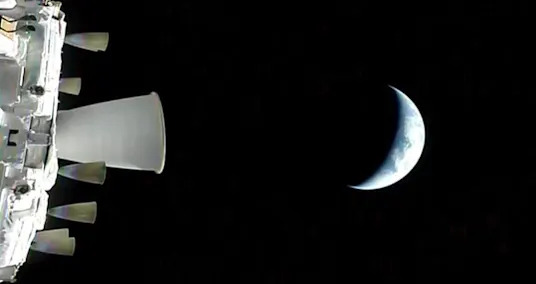
Replied Hansen: "We love those words. And we're loving the view. We're falling back to Earth real fast and looking forward to accelerating back to the moon."
The shuttle-era Orbital Maneuvering System engine at the base of the Orion capsule's service module was scheduled to fire for five minutes and 51 seconds starting at 7:49 p.m. EDT as the spacecraft raced through the low point of its elliptical orbit.
The engine firing was timed to provide a slingshot-like boost to the Orion, speeding it up to some 25,000 mph, the velocity needed to break free of Earth's gravitational clasp for a four-day trek to the moon.
Wiseman and his crewmates are the first astronauts to fly aboard a Lockheed Martin-built Orion spacecraft and the first to head for the moon since the final Apollo mission in December 1972.
In the process, they're expected to travel farther from Earth than anyone before them, reaching a distance of some 252,455 miles as they fly behind the moon, beating a record set by the crew of Apollo 13 in 1970.
But the major goal of the flight, along with putting the Orion through its paces, is to test the planning, procedures and flight control techniques needed for managing upcoming moon landing missions after a half-century gap between the Artemis and Apollo programs.
The Artemis II flight is seen by NASA as a trailblazer, demonstrating the Orion crew ferry ship can safely carry astronauts to the moon and back on a regular basis while setting the stage for one, and possibly two, landings near the moon's south pole in 2028.
Amid planning for those flights, NASA Administrator Jared Isaacman says the agency will send up another Orion crew next year to rehearse rendezvous and docking procedures with moon landers being built by SpaceX and Blue Origin. That flight, Artemis III, will be carried out in low-Earth orbit.
Isaacman says NASA will spend $20 billion over the next seven years to speed up the launch rate to a moon landing every six months while building a base near the moon's south pole.
Supreme Court expresses skepticism over Trump order to end birthright citizenship
JPMorgan Chase CEO Jamie Dimon weighs in on Iran war's economic impacts
Hawaii doctor's son testifies that his father confessed to trying to kill his stepmother
latest_posts
- 1
 New nesting beach for birds at RSPB reserve
 - 2Italian court approves extradition to Germany of Ukrainian suspect in Nord Stream pipeline blast
- 3What really happens when 140 reality stars come face to face with their biggest fans
- 4‘We are the alternative’: Anti-Hamas Gaza militia tells BBC group is receiving international support
- 5My Excursion to a Better Way of life: Health Experiences



- IDF drops over 80 explosives on Tehran weapon production sites in latest strike
- 6 Shades Brands For Seniors
- Doritos and Cheetos dial back the bright orange in new versions without artificial ingredients
- Shah Capital pushes for Novavax sale, warns of proxy fight
- Sound Propensities: 20 Methods for helping Your Insusceptible Framework
- Dutch police probe a small blast outside a pro-Israel Christian center
- Astrophotographer captures spectacular photo of Antennae Galaxies dueling in deep space
- Cruising Solo All over the Planet: An Excursion of Self-Disclosure
- Find the Insider facts of Compelling Systems administration: Building Associations for Progress