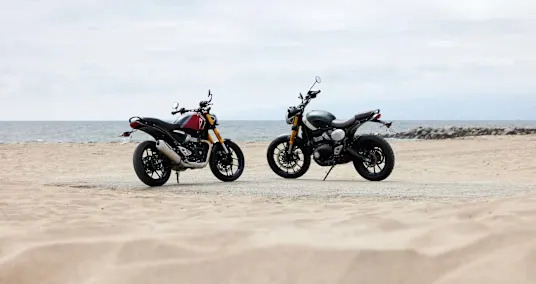
India just revised its motorcycle tax structure, so here are the changes Triumph is making to adapt for the local market.
Ever since the Triumph Speed 400 and Scrambler 400 hit the international motorcycling scene a few years ago, they've been making waves. It's not at all difficult to understand why; after all, everyone wants to ride a bike that looks and feels good, right? Packaging all that style up into an approachable, reliable package just makes all the sense in the world.
Although India is where these bikes were born, international anticipation for when they'd expand to other markets was high almost immediately. Again, that's not exactly surprising; ever since its comeback as a brand, Triumph has consistently worked hard to earn itself a reputation for offering solid bikes that are well-made, look amazing, and are (for the most part, anyway) fairly priced.
I just got back from riding the brand-new Thruxton 400 and Tracker 400 (Thruxton review is live now; Tracker review is coming soon, and video reviews will also be up on our YouTube very soon as well) and my very short summary is that they are Triumph's ethos through and through.
As such, if you're down with what Triumph likes to bring to the table, then you're probably going to like at least one (and probably more than one) of these bikes. But that's not what we're here to talk about today.
No, instead, we're here to talk about when a 400 is not a 400, but it's still a Triumph 400 anyway. Let me explain.
More Moto Math
Triumph 400s In India Are Making A Major Change
In 2025, India revised its Goods and Services Tax (GST) rates for some things, including motorbikes. To be clear, the displacement dividing line of 350cc remains the same; however, the tax rates for bikes above and below that mark have changed significantly.
Previously, bikes that were 350cc and below had a 28% GST; as of the time of writing, the level is now 18%. But what about bikes above 350cc? That's where the most substantial change happened. Previously, the effective GST was 31% for those bikes; now, it's been raised up to 40% for bikes over 350cc. Ouch.
And that's why, going forward, if you cross-shop the Triumph 400s and their specs in India vs. the Triumph 400s sold in the rest of the world, you're going to notice some differences.
Same Branding, Slightly Different Power
Triumph is still keeping its 400 branding in India for all of its TR-platform bikes. But the engines powering bikes specifically for the Indian market will have slightly smaller bores, and slightly less horsepower and torque than the international versions.
In order to meet that 350cc cutoff, Triumph (and Bajaj) are revising these engines slightly. Triumph just launched the Tracker 400 in India with its new 349cc TR engine, which produces a claimed 40 horsepower at 8,750 rpm and 32 Nm of torque at 7,500 rpm (about 23.6 lb-ft). Meanwhile, the 398cc version makes a claimed 41.4 hp at 9,000 rpm and 37.5 Nm of torque at 7,500 rpm (just under 28 lb-ft).
On paper, those are pretty small changes to keep the tax rate under control. As for how they ride in comparison to one another, I can't speak to that because I've only ridden the 398cc versions. It may or may not even be that noticeable, depending on how it's been engineered.
Will KTM engage in changes like this as well for its 390s, which are also made in cooperation with Bajaj? That remains to be seen, but the difference between an 18% tax rate and a 40% tax rate is all but impossible to ignore.
latest_posts
- 1
 The most effective method to Make a Dazzling Site in 5 Basic Advances
 - 2Clocks to go forward one hour in Europe as summer time starts
- 3Is 'Stranger Things' releasing one last episode? The 'Conformity Gate' fan theory explained as speculation mounts.
- 4US measles cases surpass 2,000, highest in 30 years: CDC
- 5The Best Music Collections of the 10 years





- More people are addicted to marijuana, but fewer of them are seeking help, experts say
- Whale stranded off Germany for days found stuck again
- 'All Her Fault' ending explained: The shocking conclusion to the psychological thriller inspired by true events
- Most loved Fish Dish: What's Your Sea Pleasure?
- Instructions to Explore the Universe of Vehicle Leases
- Etymological Investigation Disclosed: A Survey of \Dominating New Tongues\ Language Learning Application
- Venezuelan President Maduro arrives in New York following U.S. capture: Full coverage
- The Response to Fake General Knowledge: Investigating the Eventual fate of artificial intelligence
- Polish law aimed at lowering petrol prices takes effect